
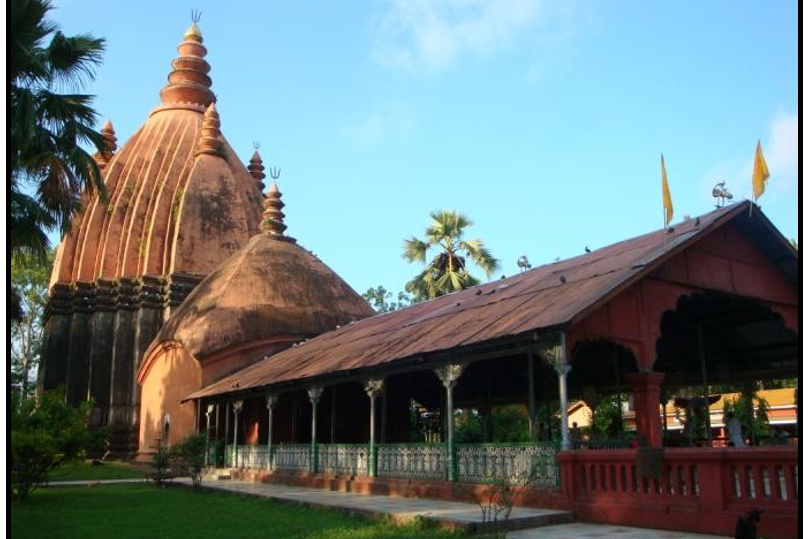
Nestled in the heart of Assam, the town of Sivasagar, literally translating to ‘the ocean of Lord Shiva’, holds within its serene embrace one of the most culturally significant temple clusters in Assam. These temples are not merely places of worship but timeless testaments to the power, artistry, and spiritual depth of the Ahom Dynasty, which ruled Assam for over six centuries.
A Glimpse into History
The Ahoms, of Tai origin, migrated to Assam in the 13th century and established a powerful kingdom that greatly influenced the region’s cultural and architectural development. The Sivasagar temples were primarily constructed during the 17-18th centuries under Ahom kings Rudra Singha, Siva Singha, and Rajeswar Singha. These temples served not only religious purposes but also stood as symbols of royal patronage and the blend of local traditions with Indo-Aryan architectural influences.
The Majestic Trio: Siva Dol, Vishnu Dol, and Devi Dol
Located on the banks of the Sivasagar tank, also known as Borpukhuri, stand three prominent temples forming the core of this sacred complex. Siva Dol, dedicated to Lord Shiva, was built by Queen Ambika Devi, consort of King Siva Singha, in 1734. With a towering height of about 104 feet, this is the tallest Shiva temple in Northeast India. The Siva Dol exhibits classic Ahom temple architecture with influences from Bengal and Odisha, ornately sculpted walls, lotus, and kalasha motifs, and a massive dome-shaped sikhara (spire). The temple becomes a hub of devotion during Maha Shivaratri, when thousands of devotees gather to offer prayers and participate in rituals. The Sivasagar tank, over 200 acres in size, adds a spiritual and visual charm to the complete complex. Designed as a water reservoir, it remains full throughout the year, showcasing the advanced hydrological knowledge of Ahom engineers. Vishnu Dol is dedicated to Lord Vishnu and smaller than the Siva Dol but similar in architectural style. This temple features beautiful motifs of different avatars of Vishnu and is aligned perfectly to the east for the rising sun to touch its spire. Devi Dol is dedicated to Goddess Durga. The Sivasagar temples exhibit a harmonious blend of nagara style architecture, which is seen across North India, with local innovations. The use of massive blocks of stone, finely carved exteriors, and symmetrical layouts reveal the engineering prowess of the Ahoms.
Preservation and Legacy
The Sivasagar group of temples is protected by the Archaeological Survey of India (ASI) and remains a center of faith, tourism, and cultural pride. It draws scholars, devotees, and curious travelers alike, all eager to experience a piece of Assam’s royal and religious past. Despite the passage of centuries, the temples continue to resonate with sacred chants, echoing the spiritual pulse of a civilization that valued devotion, design, and divine alignment. The Sivasagar temples are more than monuments, they are living legacies. Whether you are an architecture enthusiast, a spiritual seeker, or a history lover, standing beneath the spire of the Siva Dol with the Sivasagar tank shimmering beside you offers a glimpse into the soul of Assam’s majestic past.
Visiting Tips
Best time to visit: October to March (especially during Maha Shivaratri and Durga Puja)
How to reach: Sivasagar is well-connected by road and rail. The nearest airport is in Jorhat (about 75 kms away).
Nearby attractions: Rang Ghar, Talatal Ghar, Kareng Ghar, and Charaideo maidams
Hi, great content!